Blog
Types of Milling Machines: A Practical Guide to Eight Common Configurations and Milling Head Selection
2026.10.06
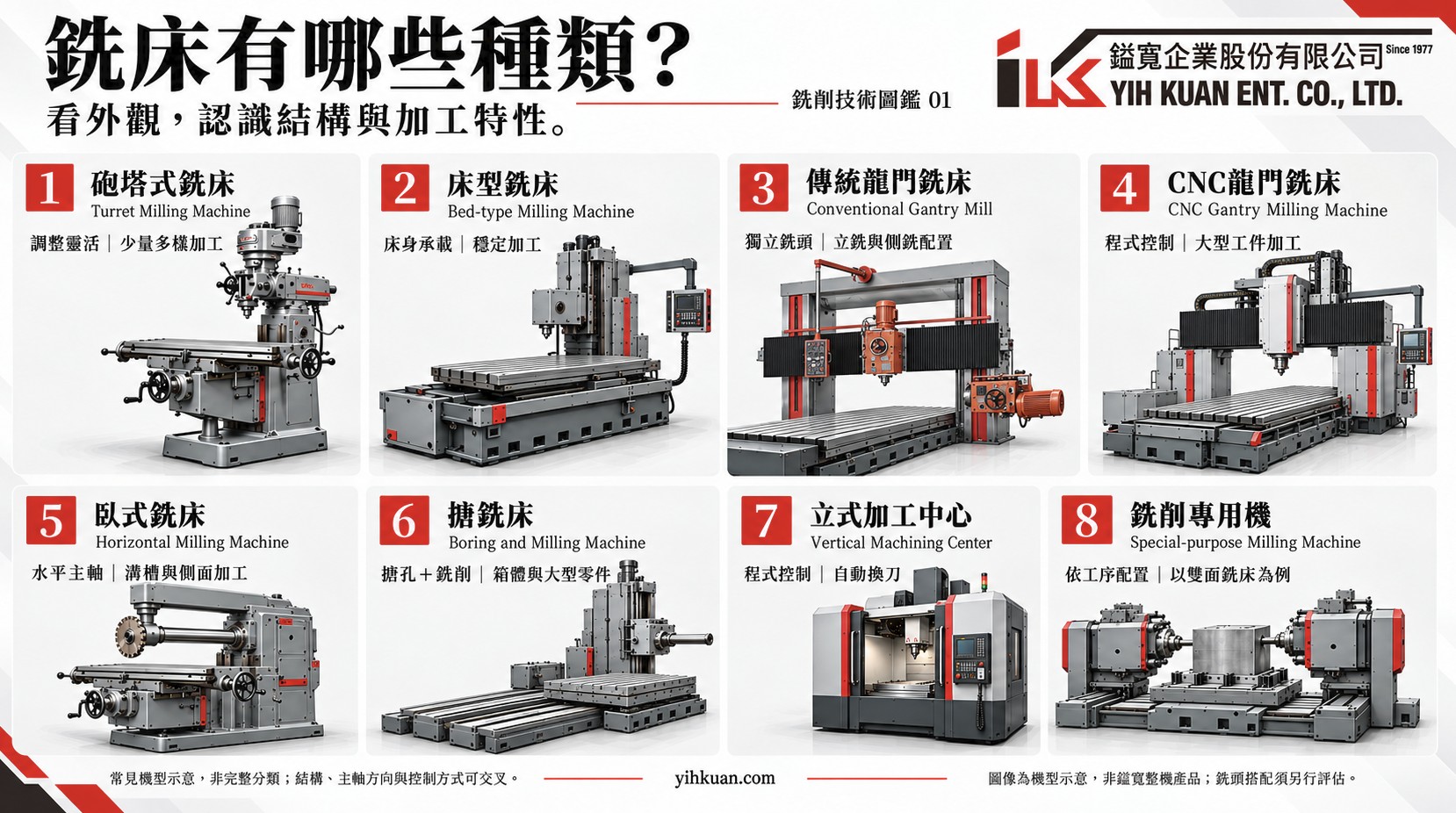
A milling machine may be a manual turret mill in a maintenance shop, a conventional gantry mill machining large fabrications, or a CNC machining center running multiple operations in one setup. The differences go beyond machine size. Structural design, spindle orientation, and control capabilities all affect how a machine approaches the workpiece and handles cutting loads.
Understanding these differences provides a useful starting point for selecting equipment, replacing a milling head, or adding machining capabilities to an existing machine.
Understanding Milling Machine Classifications
Milling machine terminology describes several different aspects of a machine:
-
Vertical and horizontal describe spindle orientation.
-
Turret, bed-type, and plano describe the machine’s structural configuration.
-
Conventional and CNC describe how machine movements are controlled.
These classifications overlap. A machine can be both a CNC mill and a bed-type mill, for example.
The following guide covers eight common machine configurations. Conventional and CNC gantry mills are listed separately to highlight differences in operation and head configuration. This is a practical overview, rather than an exhaustive classification of every milling machine design.
Common Milling Machines and YIH KUAN Milling Head Options
| Machine Type | Key Characteristics | YIH KUAN Product Direction | Representative Models |
| Turret Milling Machine | Flexible head positioning for general machining, maintenance, and low-volume work | Turret milling heads | IK-3, IK-5, and IK-6 series |
| Bed-type Milling Machine | Bed-supported table arrangement for workpiece support and machining stability | Plano milling heads, subject to machine configuration review | IK-610, IK-916, and IK-915 series |
| Conventional Plano Milling Machine | Commonly equipped with a crossrail-mounted vertical head and optional column-mounted side heads | Plano milling heads for replacement or new machine builds | IK-610, IK-916, and IK-915 series |
| CNC Gantry Milling Machine | Combines gantry construction with programmed axis motion for large-part machining | Main head selection requires mechanical and control review; angle heads may provide additional access | IK-N90 and IK-U90 angle heads; main heads evaluated individually |
| Horizontal Milling Machine | Horizontal spindle arrangement for slotting, side milling, and other operations | Milling head configurations suitable for horizontal mounting, subject to structural and drive-system review | IK-610 and IK-915 series, depending on configuration |
| Boring Mill | Combines precision bore machining with milling operations on housings and large components | Right-angle, universal, or deep-reach angle heads, subject to mounting and drive compatibility | IK-N90, IK-U90, and IK-D90/D90L |
| Vertical Machining Center | CNC operation, typically with automatic tool changing, for multiple machining processes | Angle heads for access to side or inclined surfaces | IK-N90, IK-U90, and IK-U45 |
| Special-purpose Milling Machine | Designed around a specific part or operation, such as duplex or end-face milling | Milling heads selected for cutting load, mounting orientation, and duty cycle | Application-specific selection |
The options above are starting points for engineering evaluation, not a list of direct-fit replacements. Mounting interfaces, drive arrangements, available clearance, and cutting requirements must be verified.
1. Turret Milling Machines: Flexible Setup for General-purpose Work
Turret mills typically allow the head and ram to be repositioned to suit the job. They are common in maintenance departments, toolrooms, and shops handling prototypes or short production runs.
That flexibility comes with a practical consideration: excessive ram extension or tool overhang reduces rigidity. Keep extensions as short as the setup allows, and lock unused axes and adjustment points before cutting.
2. Bed-type Milling Machines: Workpiece Support and Cutting Stability
On a typical bed mill, the table is supported by the bed, while the head moves vertically along the column. This arrangement is well suited to heavier workpieces and applications that benefit from a rigid machining setup.
Actual cutting capacity still depends on the complete machine—including the spindle, guideways, structure, and workholding—not simply its size or motor horsepower.
3. Conventional Gantry Mills: Separate Heads for Top and Side Machining
A conventional gantry mill uses two columns and a crossrail spanning the worktable. A vertical milling head is commonly mounted on the crossrail, with a side milling head available on a column to reach additional surfaces.
“Conventional” does not mean every movement is manual; powered feeds are common. If the machine’s structure and accuracy remain serviceable, replacing an individual milling head may be a practical way to extend its useful life.
4. CNC Gantry Mills: Programmed Motion for Large-part Machining
CNC gantry mills combine a large machining envelope with programmed axis motion. They are used for molds, plates, machine structures, and other large components requiring controlled toolpaths.
Automatic tool changing, five-sided machining, and simultaneous five-axis motion are configuration-dependent features. A main head replacement may also require integration with the spindle drive, orientation system, sensors, and CNC controls.
5. Horizontal Milling Machines: A Different Approach to the Cutting Surface
A horizontal mill positions the spindle approximately parallel to the table surface. Conventional designs often use an arbor-supported cutter arrangement for slotting, side milling, and related operations.
The right application depends on cutter geometry, arbor support, and workpiece access. Retrofitting a different milling head requires a review of the original machine structure and power transmission arrangement.
6. Boring Mills: Bore Accuracy and Milling Capability in One Machine
Boring mills use boring tools to bring existing holes to the required size and accuracy, while also supporting milling operations. Typical work includes machine housings, large castings, and components with critical bore locations.
An angle head may provide access to additional surfaces, but mounting support, torque transmission, and reach must be evaluated. Longer extensions generally place greater demands on rigidity.
7. Vertical Machining Centers: Multiple Operations with Automatic Tool Changing
A vertical machining center typically combines a vertical spindle, CNC control, and a tool magazine. It can perform milling, drilling, tapping, and other operations within a programmed sequence.
Adding an angle head may enable side machining, but clearance, mounting support, and allowable loads must be checked. Compatibility with the spindle taper does not establish compatibility with the machine’s automatic tool changer.
8. Special-purpose Milling Machines: Built Around the Part and Process
Special-purpose machines are designed for a defined operation or part family. Examples include opposing-head machines for machining two sides of a workpiece and dedicated systems for machining the ends of long components.
These machines prioritize repeatability and production requirements. Milling heads should be selected for the material, tooling, cutting load, mounting orientation, and operating duty cycle.
Selecting a Milling Head Takes More Than Horsepower and RPM
Cutting forces pass through the tool, spindle, milling head, mounting interface, and machine structure. A weak or flexible connection anywhere in that path can limit machining performance.
Installing a higher-horsepower head does not automatically increase the cutting capacity of the entire machine.
A proper evaluation considers torque at the required operating speed, head weight, mounting rigidity, and the condition of the machine. Vertical and horizontal mounting arrangements also require confirmation of the head’s suitability and lubrication requirements.
Evaluate the Machine Before Replacing the Head
When the bed, guideways, feed system, and geometric accuracy remain suitable for the work, a replacement milling head or an additional angle head may be a practical alternative to replacing the complete machine.
To begin an application review, provide:
-
Machine information: Overall photos, machine make and model, and the existing milling head model.
-
Mounting details: Interface dimensions, attachment method, installation orientation, and available clearance.
-
Machining requirements: Workpiece material, surfaces to be machined, cutter diameter, operating speed, and cutting parameters.
YIH KUAN manufactures turret milling heads, gantry milling heads, and angle heads for machine builders, retrofit projects, and special-purpose equipment. Evaluating the machine and the cutting process together helps identify a head configuration that supports the application and keeps serviceable equipment productive.

