Blog
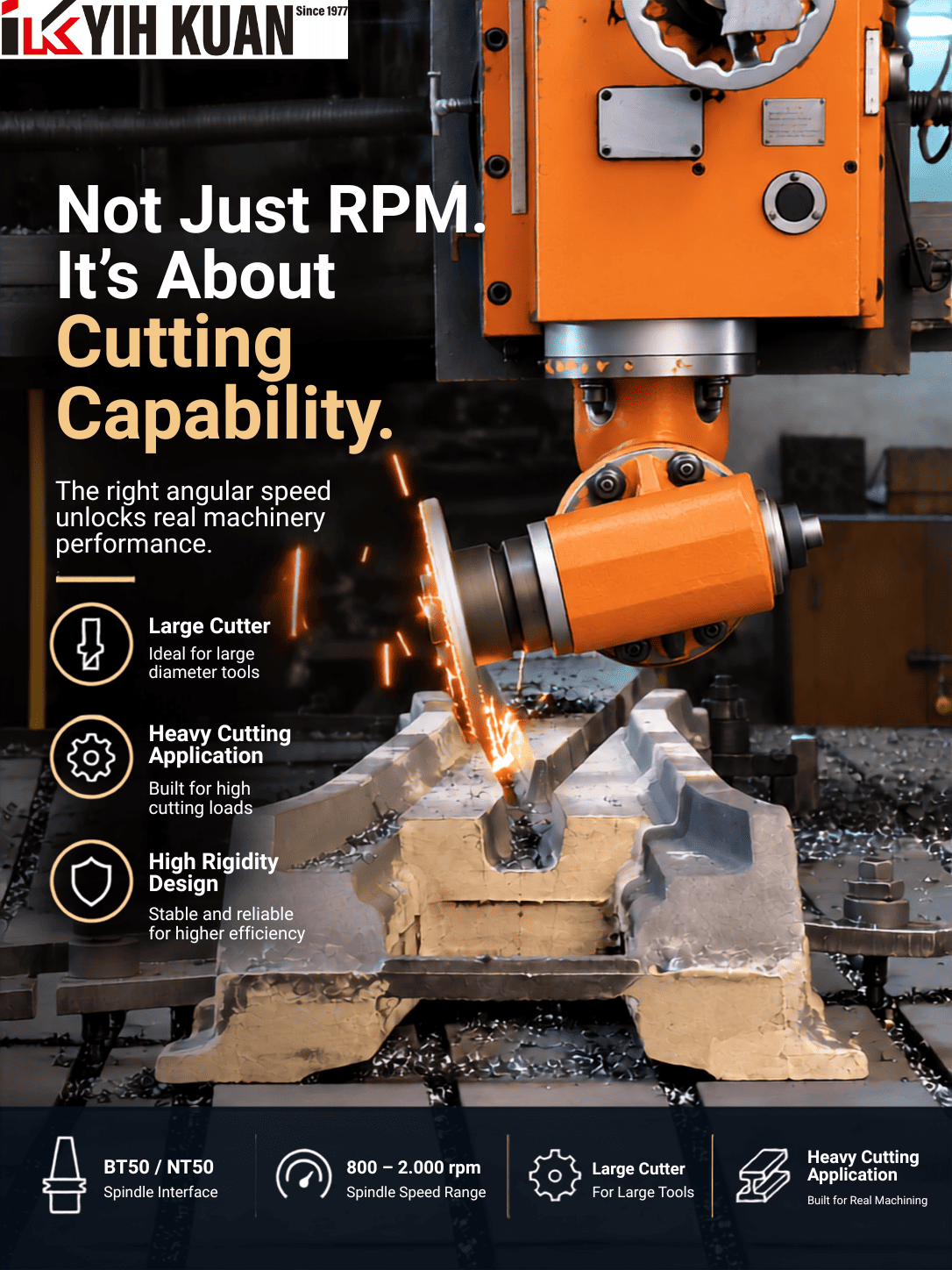
Not Just RPM. It’s About Cutting Capability.
2026.09.16
How to Choose an Angle Head? Manual or Automatic Is Only Part of the Decision
The right choice depends on how you cut — not just how you operate.
When selecting an angle head, one of the first questions many customers ask is:
“Is it manual or automatic?”
The operating method is certainly important. However, an angle head is ultimately a machining tool, and the right selection depends on much more than its level of automation.
Workpiece material, cutter diameter, spindle speed, cutting load, machine conditions, and the frequency of angle changes should all be considered.
At YIH KUAN, we believe the selection process should follow a simple principle:
First, make sure it can handle the cutting. Then decide how you want to operate it.
Start with the Cutting Requirements
Before comparing manual, semi-automatic, and fully automatic angle heads, several basic machining conditions should first be confirmed:
Workpiece Material | Cutter Diameter | Spindle Speed | Depth of Cut | Width of Cut | Feed Rate | Machine Power | Spindle Interface
For example, machining aluminum with a Ø30 mm cutter and machining tool steel with a Ø150 mm face mill can require very different angle head specifications.
No matter how advanced the automation system is, if the speed range, structure, or cutting capability does not match the actual machining requirements, it may not be the right solution.
Higher RPM Is Not Always Better
Some angle heads on the market emphasize spindle speeds of 6,000 rpm, 8,000 rpm, or even higher.
High-speed angle heads have clear advantages when using smaller cutters, performing high-speed machining, or working under conditions that require higher cutting speeds.
However, when larger cutters are used, steel is being machined, or heavier cutting loads are involved, maximum spindle speed should not be the only consideration.
Other factors such as torque requirements, structural rigidity, cutter size, and cutting load become equally important.
High speed is one type of capability. Torque, rigidity, and the ability to withstand cutting loads are also essential machining capabilities.
Neither approach is inherently better. They are designed for different machining requirements.
Why Does YIH KUAN Focus on 800–2,000 rpm?
YIH KUAN angle heads are primarily designed for BT50 / NT50 machine applications, with spindle speeds mainly ranging from 800 to 2,000 rpm.
If maximum spindle speed alone is compared, these are not high-speed angle heads designed to reach 6,000–8,000 rpm.
That is because our product focus is different.
YIH KUAN angle heads are designed with an emphasis on larger cutters, low-to-medium spindle speeds, higher torque requirements, structural rigidity, and heavier cutting applications.
For applications such as machining the sides of large workpieces, cutting steel, or using larger face mills, the key question is often not:
“What is the maximum RPM of this angle head?”
but rather:
“Is this angle head suitable for my cutter and actual cutting conditions?”
Manual, Semi-Automatic, and Fully Automatic Angle Heads: What Is the Difference?
Once the required cutting capability has been confirmed, the next step is to determine the appropriate operating method.
Manual, semi-automatic, and fully automatic angle heads should not simply be viewed as “basic, intermediate, and advanced” options.
Each is designed for different machining frequencies, operating requirements, machine configurations, and levels of automation.
| Comparison | Manual Angle Head | Semi-Automatic Angle Head | Fully Automatic Angle Head |
|---|---|---|---|
| Angle Head Installation | Manual | Manual | Automatic / Depends on system design |
| Clamping | Manual | Manual | Automatic / Depends on system design |
| Angular Rotation / Indexing | Manual | Automatic | Automatic / Depends on system design |
| Operator Involvement | Higher | Medium | Low |
| Angle Change Efficiency | Standard | High | High |
| System Complexity | Low | Medium | High |
| Machine Integration Requirements | Low | Medium | High |
| Initial Investment | Lower | Medium | Higher |
| Retrofit Flexibility | High | High | Depends on machine configuration |
| Best Suited For | Infrequent angle changes | Frequent angle changes after installation | Highly automated, continuous production |
| Available from YIH KUAN | ✓ | ✓ | — |
Note: Definitions of semi-automatic and fully automatic angle heads may vary among manufacturers. At YIH KUAN, a semi-automatic angle head refers to manual installation/clamping combined with automatic angular rotation/indexing.
-
Manual Angle Head: Simple, Direct, and Flexible for Retrofit Applications
When the machining direction remains relatively fixed, or the angle only needs to be changed occasionally, a manual angle head can often meet the requirement effectively.
The operator manually installs and clamps the angle head, sets the required machining angle, and then begins machining.
This approach requires less system integration and provides excellent flexibility for existing machines.
For existing gantry milling machines, boring mills, and other large machine tools, a manual angle head can be a practical way to add side machining or special-angle machining capability without making extensive modifications to the original machine.
-
Semi-Automatic Angle Head: Automating the Action That Happens Most Often
At YIH KUAN, a semi-automatic angle head does not mean automatic head changing.
The angle head is still manually installed and clamped by the operator. Once installed, however, angular rotation/indexing can be performed automatically.
Manual Clamping + Automatic Angular Rotation
This design is particularly suitable when the angle head remains installed on the machine, but the machining direction needs to be changed frequently during the machining process.
In this situation, the repetitive action is not changing the entire angle head.
It is changing the machining angle.
By automating the action that occurs most frequently, a semi-automatic angle head can provide a practical balance between machining efficiency, system complexity, and investment cost.
-
Fully Automatic Angle Head: Designed for Highly Automated Production
Fully automatic angle head systems become more valuable in high-volume production, unattended machining, or applications requiring frequent automatic changes between tools and angle heads.
Depending on the machine and system design, integration may involve the ATC, tool magazine, spindle interface, positioning mechanism, control signals, PLC, machine space, and maintenance requirements.
As a result, a fully automatic solution is not necessarily the best choice for every machine.
Its value generally increases as production volume, head-changing frequency, and unattended machining requirements increase.
So, Which Angle Head Is Right for You?
There is no single angle head that is ideal for every machining application.
If your application involves smaller cutters, high spindle speeds, frequent automatic head changes, and unattended production, a high-speed fully automatic angle head may be a more suitable solution.
However, if your machining conditions involve BT50 / NT50, larger cutters, low-to-medium spindle speeds, higher torque requirements, or heavier cutting, maximum RPM and automation level should not be the only criteria.
The right angle head should be selected based on:
Cutting Requirements × Machine Conditions × Operation × Investment
First consider how you need to cut. Then decide how much automation you actually need.
FAQ | Frequently Asked Questions About Angle Heads
Q1. What is the main difference between a manual and an automatic angle head?
The main difference lies in operation and system integration. A manual angle head requires manual installation, clamping, and angle adjustment, while an automated angle head can automate some or all of these operations depending on its design.
The selection should still be based on the actual machining requirements, frequency of use, and machine configuration.
Q2. What is a YIH KUAN semi-automatic angle head?
A YIH KUAN semi-automatic angle head uses the concept of manual installation/clamping + automatic angular rotation/indexing.
The angle head itself is not automatically exchanged. Once installed, however, automatic angular movement reduces the need for repeated manual angle adjustment.
Q3. Is a higher RPM always better for an angle head?
No.
Higher spindle speeds are suitable for smaller cutters and applications requiring higher cutting speeds. When larger cutters or heavier cutting loads are involved, torque requirements, structural rigidity, cutter size, and cutting capability should also be considered.
Maximum RPM is only one factor in angle head selection.
Q4. Why are YIH KUAN angle heads mainly designed for 800–2,000 rpm?
YIH KUAN BT50 / NT50 angle heads are primarily positioned for larger cutters, low-to-medium spindle speeds, higher torque requirements, and heavier cutting applications.
Therefore, achieving the highest possible spindle speed is not the primary design objective.
Q5. How do I select a BT50 / NT50 angle head?
We recommend providing the following information:
Workpiece material, cutter type and diameter, required spindle speed, depth of cut, width of cut, feed rate, machine power, spindle interface, and machine photos.
For retrofit applications, mounting interface details and PCD dimensions are also recommended so that compatibility can be evaluated more accurately.
Q6. Can an angle head be installed on an existing or older machine?
In many cases, yes, but compatibility must be evaluated individually.
Important factors include the spindle type, available installation space, flange interface, PCD, machine structure, and actual machining requirements.
Providing complete machine photos and interface dimensions will help us conduct an initial evaluation more efficiently.
The Right Angle Head Is More Important Than the Highest Specification
If you are evaluating a BT50 / NT50 angle head and are unsure whether a manual or semi-automatic solution is more suitable — or whether 800 rpm or 2,000 rpm better matches your application — send YIH KUAN your machine photos, workpiece material, cutter size, and cutting conditions.
We will evaluate the application based on your actual machining requirements and help identify a suitable angle head solution.
First understand the cutting. Then choose the automation.
YIH KUAN | Upgrade Your Machine. Not Replace It.

