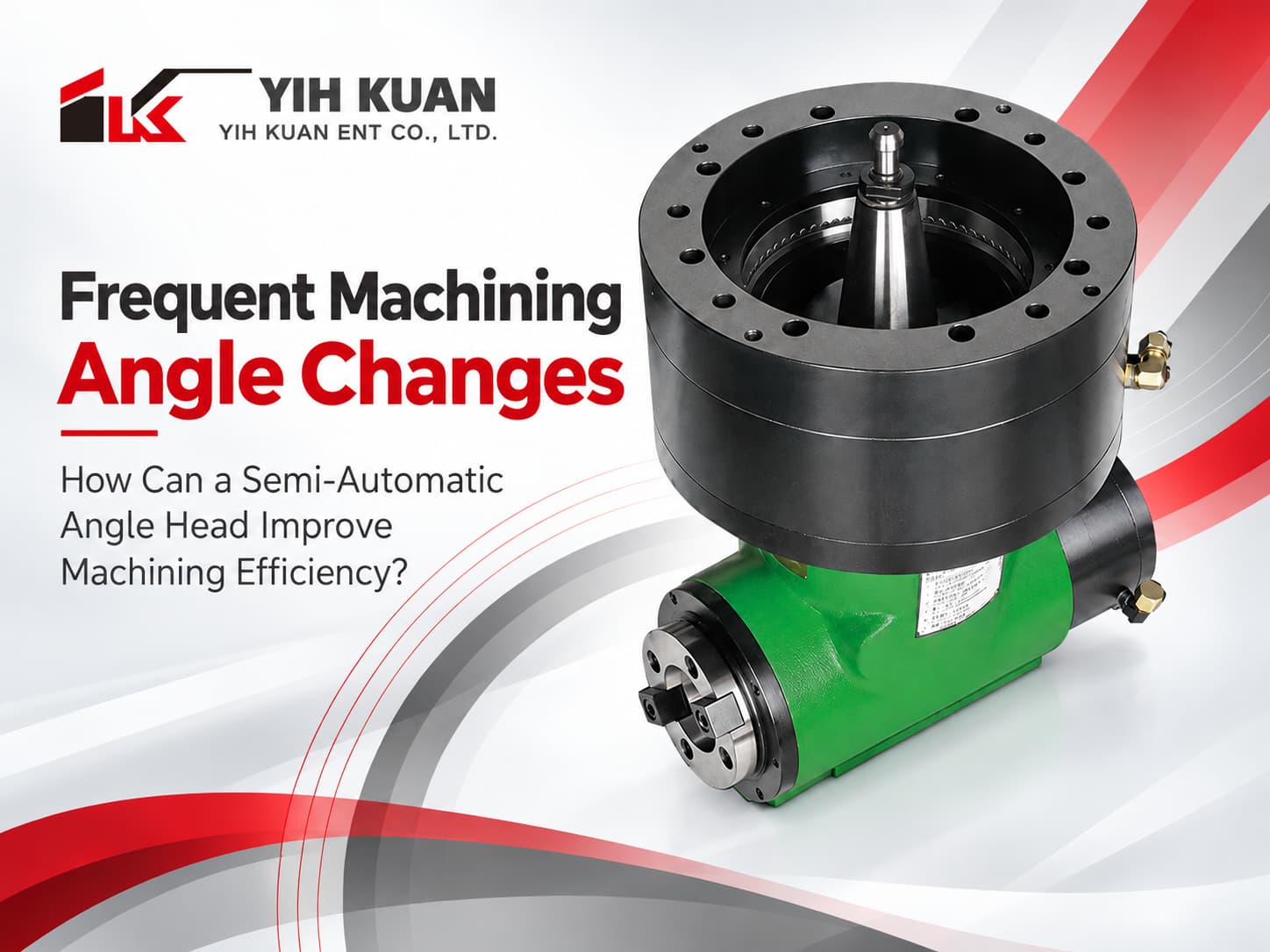
When machining large workpieces, molds, or multi-sided parts, cutting speed is not the only factor. Angle adjustment and positioning are also key to improving overall machining efficiency.
Loosen, rotate, check the position, re-tighten, and then start the next operation. When these steps are repeated every day, optimizing the angle-change process can help shorten pre-machining setup time.
For shops that frequently change machining directions, a semi-automatic angle head is a configuration worth evaluating.
Choose the Right Angle Head Configuration Based on Angle Change Frequency
Manual and semi-automatic angle heads each suit different machining scenarios. If a workpiece is mainly machined from one direction, or the angle only needs to be adjusted once or twice a day, a manual angle head meets everyday machining needs with simple, direct operation.
An angle head expands the side and multi-directional machining capabilities of an existing machine, helping the tool reach specific machining positions. When a workpiece requires frequent changes in machining direction, a semi-automatic configuration can further simplify angle changes and positioning.
When evaluating a configuration, start with one practical question:
“How many times a day do we change the machining angle, and how much time do these adjustment and positioning tasks take in total?”
Evaluating angle-change frequency together with setup time gives a clearer picture of which configuration is right for you.
If most work stays at a fixed angle, a manual configuration is easy to operate. If you frequently switch between several fixed directions, consider the process benefits of a semi-automatic configuration.
The following four machining scenarios can serve as a reference when evaluating a semi-automatic configuration.
1. One Workpiece Requires Machining from Multiple Directions
Large box-type parts, molds, and machine components often need machining on the front, left and right sides, or even at different angles.
With a manual angle head, every change of direction requires readjustment and verification.
As this process repeats, the time spent adjusting and verifying angles becomes part of the overall machining cycle time.
The value of a semi-automatic angle head lies in simplifying angle changes and positioning.
YIH KUAN’s IK-N95 Position Chainring (semi-automatic hydraulic) can be paired with a suitable angle milling head, making it ideal for applications that require frequent changes in machining angle and direction.
2. Repeated Machining Requires a Stable Angle Positioning Process
The time needed to change angles includes not only the adjustment itself, but also positioning and verification afterward.
When machining the same part repeatedly, optimizing angle adjustment, positioning, and verification for every workpiece helps improve cycle time.
If the machining program frequently switches between several fixed angles, a semi-automatic angle head can deliver greater value.
The YIH KUAN IK-N95 Position Chainring can be paired with different angle milling heads as needed and is available in 1° or 5° indexing configurations, making it suitable for machining that requires repeated angle positioning.
3. Large Workpieces Require Efficient Flipping and Clamping
Flipping a large workpiece usually involves lifting, moving, repositioning, aligning, and clamping.
With the right angle milling head configuration, you can reduce the need to flip and reposition workpieces, making multi-face machining smoother.
An angle milling head changes the tool’s machining direction directly, reducing the need to flip the workpiece.
If a workpiece requires side machining with frequent changes in direction, consider pairing the IK-N95 Position Chainring with the IK-U90 90° Universal Milling Head for more flexible multi-angle machining.
4. Operators Repeatedly “Loosen, Adjust the Angle, and Tighten”
Manual adjustment suits work with a low angle-change frequency. When adjustments are repeated a dozen or more times a day, it is worth evaluating the process benefits of a semi-automatic configuration.
These adjustment and positioning steps are part of setup time. Optimizing the process helps devote more working time to actual cutting.
In short:
Manual:
Install and manually lock the angle head → Cut → Stop the machine → Loosen → Adjust the angle → Verify → Tighten → Resume machining
Semi-automatic:
Install and manually lock the angle head → Cut → Automatic angle rotation and positioning → Resume machining
Actual time savings depend on workpiece and machine conditions. When angle adjustment has become a routine daily task, include angle-change frequency, positioning requirements, and setup time in your evaluation of a semi-automatic configuration.
Which Angle Head Fits Your Machining Process?
| Your Machining Process | Recommended Angle Head Configuration |
|---|---|
| Fixed angle, occasional adjustment | Manual configuration |
| Mainly single-direction machining | Manual configuration |
| Multi-angle / multi-face machining | Consider semi-automatic |
| Frequent changes in machining angle | Semi-automatic is more convenient |
| Large workpieces where flipping should be reduced | Angle head recommended |
| Shorter adjustment and positioning time needed | Semi-automatic has the advantage |
When selecting an angle head, consider not only the machining direction but also how often the angle changes. For complex surfaces or continuous simultaneous multi-axis machining, a 5-axis machine should be evaluated. If you mainly switch back and forth between several fixed directions, choose a manual or semi-automatic configuration based on adjustment frequency.
Conclusion
Manual angle heads are suited to work with low adjustment frequency and clearly defined machining directions. For machining that involves frequent angle changes and repeated positioning, a semi-automatic configuration is an option for optimizing the setup process.
YIH KUAN offers a range of angle milling heads, including the IK-N90 90° Angular Head, IK-D90 / IK-D90-L 90° Deep Milling Head, IK-U45 45° Universal Milling Head, and IK-U90 90° Universal Milling Head. Users can select the angle milling head that fits their machining needs and pair it with the IK-N95 Position Chainring, which is available in two configurations: 1° indexing and 5° indexing. The final combination should be confirmed based on the machine, workpiece size, machining direction, and frequency of use.
Share your machining requirements and daily usage habits with us, and YIH KUAN will help you evaluate the right angle head and configuration.
Contact YIH KUAN to Evaluate the Right Angle Head Configuration

