Blog
Large Housing Machining: How Can Angle Milling Heads Expand Existing Machine Capabilities?
2026.07.15
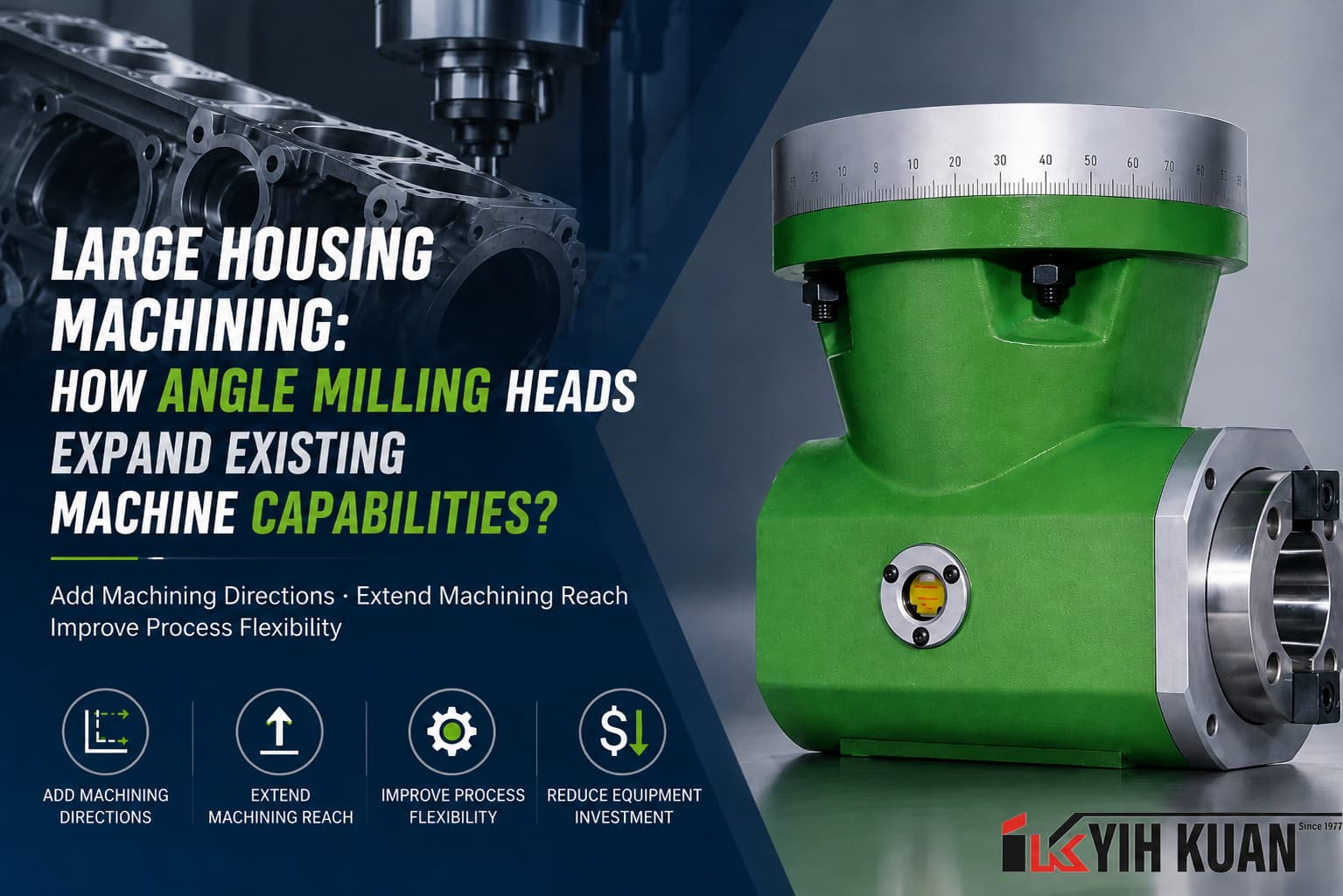
Large housing components are commonly found in gearboxes, speed reducers, pumps, valve bodies, machinery, and various industrial structures. These workpieces often feature side holes, deep cavities, internal machining areas, and mounting or positioning features in different directions.
For high-volume production, manufacturers typically use horizontal machining centers, 4-axis or 5-axis machines, or dedicated machining systems to complete multi-side machining through automation and multi-axis control.
However, for certain large, low-volume, repair-related, or retrofit housing components, investing in a new multi-axis machine may not always be the most cost-effective solution. When an existing machine is limited by machining direction, machine travel, or tool accessibility, manufacturers can consider adding an Angle Milling Head to expand the machining capabilities of existing equipment.
An angle milling head is not intended to replace a 4-axis or 5-axis machining center. Instead, it provides a flexible machining solution for specific workpieces and existing machine conditions.
When Should You Consider an Angle Milling Head?
1. Large Workpieces Are Difficult to Reposition
When a housing component is large and heavy, repositioning may require a crane or other lifting equipment. Every additional setup increases handling, positioning, and realignment time.
If the machining features are mainly located on the side of the workpiece, a fixed 90° Angular Milling Head can redirect the original vertical spindle output into a horizontal direction, allowing the cutting tool to directly reach certain side holes, side walls, or horizontal machining positions.
With the right machine and workpiece configuration, an angle milling head may help reduce some workpiece repositioning and repeated clamping operations.
2. Existing Equipment Lacks a Required Machining Direction
Some conventional gantry milling machines, CNC gantry machines, boring and milling machines, or special-purpose machines may have sufficient rigidity and working space, but their spindles can only machine in a fixed direction.
When a workpiece requires horizontal, vertical, or angled machining, the existing equipment may not be able to complete the operation directly.
In such cases, a fixed 90° Angular Milling Head or Universal Milling Head can be selected according to the required machining direction, allowing existing equipment to gain additional tool output directions.
This type of solution is especially suitable for low-volume, high-mix production, one-off components, repair parts, or special workpieces where purchasing an entirely new machine for a single machining feature may not be necessary.
3. A Standard Spindle Cannot Reach Deep Machining Areas
Some housing components contain deep cavities, recessed structures, internal side walls, or machining positions located farther inside the workpiece.
Even when the machining direction is correct, a standard spindle or conventional angle milling head may still be unable to effectively reach the internal area because of insufficient length.
Simply increasing tool or toolholder overhang may reduce rigidity, increase vibration, affect machining accuracy, or create interference problems.
In these situations, manufacturers can consider using a 90° Deep Milling Head . Its extended head structure increases machining reach and allows the tool to access positions that may be difficult for a standard angle milling head to reach.
4. Repair Parts or Low-Volume Components Make Process Redesign Impractical
Repair parts often present challenges such as incomplete drawings, unusual workpiece dimensions, very low production quantities, or original equipment that has already been discontinued.
If only a small number of parts need to be machined, redesigning fixtures and processes or purchasing a new machine may result in excessive cost.
By combining an angle milling head with existing equipment, manufacturers can adjust the machining direction according to actual workpiece conditions and improve process flexibility.
This is also an important advantage of angle milling heads in large machinery repair, equipment refurbishment, mold repair, and special component machining.
Different Machining Limitations Require Different Milling Head Solutions
When selecting an angle milling head, manufacturers should not compare only spindle speed or external dimensions. The first step is to identify the actual machining limitation.
| Machining Requirement | Milling Head to Evaluate First |
|---|---|
| Fixed 90° side machining | 90° Angular Milling Head |
| Side machining with higher-torque cutting requirements | IK-A90 90° Angular Milling Head |
| Side machining with greater emphasis on higher speed and precision | IK-N90 90° Angular Head |
| A standard angle milling head is not long enough to reach deep machining positions | IK-D90 / IK-D90-L 90° Deep Milling Head |
| The workpiece includes inclined surfaces or different machining directions | IK-U45 45° Universal Milling Head / IK-U90 90° Universal Milling Head |
| The existing spindle requires greater machining reach | IK-E93A / IK-E95A Extension Milling Head |
The table above should only be used as an initial reference. Final selection should be based on workpiece dimensions, material, machining direction, tool size, machine interface, and actual cutting conditions.
Fixed 90° Angular Milling Heads: Adding Side Machining Capability
If the primary requirement is to redirect a vertical spindle output into a horizontal machining direction, a fixed 90° Angular Milling Head can be considered.
For example, IK-A90 90° Angular Milling Head and IK-N90 90° Angular Head both provide 90° tool output, but they are designed for different machining priorities.
IK-A90: Designed for High-Torque Machining
The IK-A90 90° Angular Milling Head features an NT50 spindle taper and a maximum spindle speed of 800 rpm, making it suitable for larger tools, higher cutting loads, or heavier cutting conditions.
If a large housing component requires side milling, larger-diameter machining, or higher-torque cutting, the IK-A90 can be evaluated as a suitable option.
IK-N90: Designed for High-Speed Precision Machining
The IK-N90 90° Angular Head features an NT50 spindle taper and reaches a maximum spindle speed of 2,000 rpm, positioning it for higher-speed and precision machining.
If the workpiece material is lighter, the cutting tool is smaller, or the application places greater emphasis on surface finish and spindle speed, the IK-N90 can be considered.
Therefore, a higher spindle speed does not automatically mean a milling head is more suitable. Selection should be based on tool diameter, workpiece material, cutting load, and surface finish requirements.
90° Deep Milling Heads: Extending Tool Accessibility
When the machining direction is correct but a conventional angle milling head still cannot reach a deeper area of the workpiece, manufacturers can consider the IK-D90 / IK-D90-L 90° Deep Milling Head .
The main purpose of this type of milling head is not only to redirect the machining direction by 90°, but also to extend the machining range through a longer head structure.
Typical machining positions to evaluate include:
- Deep housing cavities
- Internal side walls
- Recessed structures
- Deeper side holes
- Areas where a standard angle milling head may interfere with the workpiece
Depending on the configuration, the IK-D90 series offers maximum spindle speeds of either 800 rpm or 2,000 rpm, corresponding to higher-torque or higher-speed precision machining conditions.
Universal Milling Heads: Greater Flexibility for Multi-Angle Machining
If the workpiece includes not only fixed horizontal or vertical features, but also inclined surfaces, angled holes, or machining positions in different directions, a Universal Milling Head can be considered.
The IK-U45 45° Universal Milling Head and IK-U90 90° Universal Milling Head can be adjusted to accommodate different machining directions.
These milling heads are suitable for applications such as:
- Inclined surface machining
- Holes at different angles
- Multi-directional mounting features
- Large components that are difficult to reposition frequently
- Low-volume, high-mix special workpieces
- Expanding machining directions on special-purpose or existing machines
The main advantage of a Universal Milling Head is greater flexibility in machining direction. Before selection, however, it is also important to confirm the angle adjustment method, available interference clearance, tool length, and actual cutting load.
What Information Should Be Provided Before Selecting an Angle Milling Head?
Whether an angle milling head can be successfully installed and used depends not only on product specifications, but also on the overall configuration of the machine, workpiece, cutting tool, and fixture.
Before selecting a milling head, it is recommended to provide the following information:
- Machine brand and model
- Spindle interface and drive method
- Spindle face dimensions and PCD hole pattern
- Workpiece drawing and overall dimensions
- Workpiece material
- Actual machining position and direction
- Machining depth
- Tool type and diameter
- Required spindle speed and cutting load
- Machine X-, Y-, and Z-axis travel
- Available clearance between the workpiece and fixture
- Photos or videos of the actual machining setup
If a connecting flange is required, the spindle connection face, drive block position, flange thickness, and fastening method should also be confirmed to evaluate overall installation feasibility.
The Value of an Angle Milling Head Lies in Expanding Existing Machine Capabilities
For large, low-volume, repair-related, or special housing components, machining efficiency does not always come from higher spindle speeds or more advanced machines.
Sometimes, the real problems are:
- The existing spindle cannot reach the side of the workpiece
- The large workpiece is difficult to reposition
- The machine lacks horizontal or angled machining capability
- The standard spindle cannot reach into a deep cavity
- Low-volume production does not justify investing in an entirely new machine
- The existing machine still has useful service life but lacks sufficient machining directions
Under these conditions, a suitable Angle Milling Head can help existing equipment gain additional machining directions, extend machining reach, and improve process flexibility.
An angle milling head is not the standard solution for every housing machining application, nor is it intended to replace a 4-axis or 5-axis machining center. However, under the right workpiece and machine conditions, it can become an important tool for machine upgrades and special machining requirements.
Conclusion
When evaluating an angle milling head, manufacturers should begin with the actual machining limitation rather than simply comparing models and spindle speeds.
Is the most difficult challenge side machining, reaching deeper positions, machining at different angles, or repositioning a large workpiece?
YIH KUAN provides fixed 90° Angular Milling Heads , 90° Deep Milling Heads , Universal Milling Heads , and Extension Milling Heads , which can be evaluated according to machining direction, depth, spindle speed, torque requirements, and machine conditions.
If you have large housings, repair parts, low-volume special workpieces, or existing machine retrofit requirements, provide your machine model, spindle specifications, workpiece drawing, machining position, and current machining challenges. YIH KUAN can help you evaluate a suitable milling head solution.

