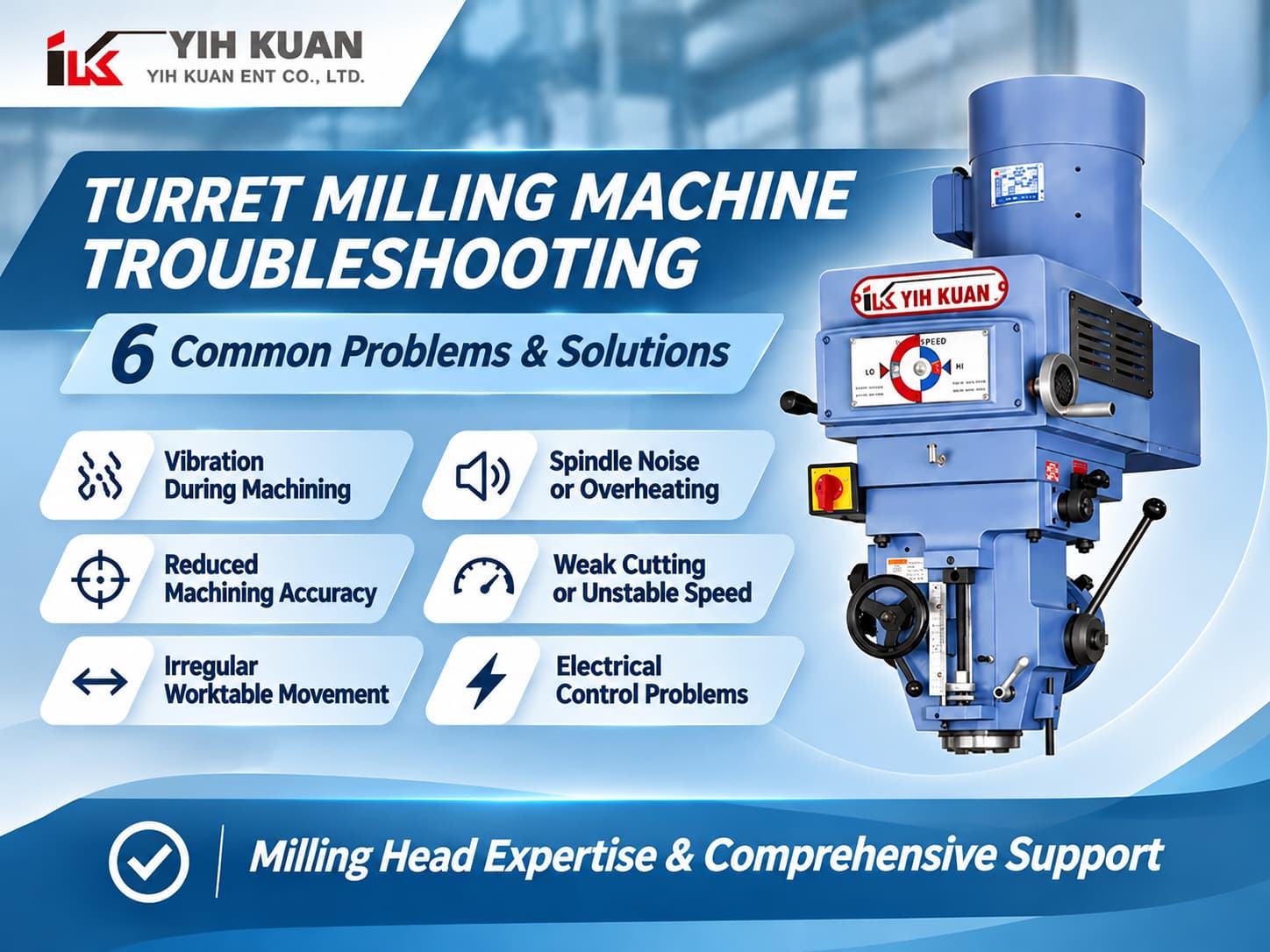
Is your turret milling machine experiencing unexpected vibration, spindle noise, declining machining accuracy, or irregular table movement? Which component is causing the problem? Should you replace the milling head or repair the entire machine?
Taichung is one of Taiwan's major machine tool and precision machining industry hubs. Many mold manufacturers, metalworking companies, and machining workshops rely on turret milling machines for daily production. However, machine problems can originate from cutting tools, machining parameters, milling heads, worktables, or other mechanical components. These issues do not necessarily mean the entire machine needs replacement.
YIH KUAN specializes in milling head manufacturing and applications. This guide explains six common turret milling machine problems and provides practical troubleshooting directions to help operators identify potential causes and determine when professional assistance may be required.
1. What Are the Six Most Common Turret Milling Machine Problems?
Over time, turret milling machines may develop operational problems due to component wear, changing machining conditions, or improper machine adjustments.
When an issue occurs, first record when it happens. Does it occur during idle spindle operation, cutting, speed changes, or table movement? These observations can help narrow down possible causes.
| Common Problem | Possible Components Involved | Recommended Approach |
|---|---|---|
| Excessive machining vibration | Cutting tools, fixtures, spindle, machine structure | Check machining conditions before inspecting mechanical components |
| Spindle noise or overheating | Lubrication, belts, bearings, transmission components | Identify when the issue occurs and inspect the milling head if necessary |
| Reduced machining accuracy | Cutting tools, spindle, worktable, guideways | Identify the source of error and inspect machine geometry |
| Weak cutting performance or unstable spindle speed | Cutting load, motor, belts, transmission system | Compare machining conditions and power transmission performance |
| Irregular worktable movement | Guideways, lead screws, feed mechanisms | Inspect the movement mechanism and lubrication |
| Electrical control problems | Switches, wiring, electrical control system | Stop the machine and arrange a professional inspection |
These symptoms are not always independent. For example, excessive vibration may also reduce surface finish quality, while abnormal spindle noise may occur together with overheating.
Therefore, troubleshooting should consider the overall operating conditions rather than identifying a faulty component based on a single symptom.
2. What Should You Check When a Turret Milling Machine Vibrates During Cutting?
Excessive vibration is a common issue in turret milling operations. However, the milling head is not necessarily the source of the problem.
We recommend checking the following factors in sequence:
- Inspect the cutting tool
Tool wear, damaged cutting edges, or excessive tool overhang can reduce cutting stability and cause chatter marks on the workpiece.
- Review cutting parameters
Spindle speed, feed rate, and depth of cut all affect machining stability. When the workpiece material or tool changes, previously used cutting parameters may no longer be suitable.
- Check workpiece clamping
Insufficient clamping force, loose fixtures, or excessive workpiece overhang may also cause vibration.
- Inspect the spindle and machine structure
If the cutting tool, machining parameters, and workpiece clamping appear normal but vibration continues, further inspection may be needed. Check spindle runout, bearings, spindle quill clearance, and machine structural conditions.
If a machine previously operated smoothly but repeatedly produces chatter marks under the same machining conditions, mechanical wear or looseness should be considered.
Key Takeaway: Determine whether vibration originates from cutting conditions or mechanical components before deciding to replace the milling head.
3. Does Spindle Noise or Overheating Mean the Milling Head Is Faulty?
Not necessarily.
Unusual spindle noise or temperatures significantly higher than normal may be related to lubrication, belts, bearings, or internal transmission components.
When these symptoms occur, consider the following observations:
- Does the noise occur even when the spindle is running without cutting?
- Does the noise become more noticeable as spindle speed increases?
- Is the noise accompanied by vibration or abnormal temperature increases?
- Does the problem occur only under specific machining loads?
These observations can support troubleshooting, but they cannot independently confirm which component has failed.
If excessive noise, rapid overheating, or severe vibration occurs, stop the machine and arrange an inspection by qualified personnel.
YIH KUAN has previously explained milling head lubrication, belt inspection, and routine maintenance in a dedicated article. For additional details, please refer to the following guide.
4. When Machining Accuracy Declines, Should You Inspect the Milling Head or the Worktable First?
Inconsistent workpiece dimensions, increased tool marks, or unstable machining quality may be related to the spindle, worktable, or other mechanical components.
The first step is to determine when the accuracy problem occurs.
Situation 1: Problems Occur During Spindle Cutting
If the workpiece repeatedly shows chatter marks, unusual tool marks, or unstable cutting performance, begin by checking tool clamping and spindle conditions.
Excessive spindle runout, bearing wear, or abnormal spindle quill clearance may indicate that the milling head requires further inspection.
Situation 2: Problems Occur During Worktable Movement or Positioning
If the table experiences unusual resistance or backlash, or machining errors vary across different table positions, inspect the guideways, lead screws, feed mechanisms, and machine geometry.
Workpiece clamping and measurement methods may also affect machining results.
Therefore, reduced accuracy should not automatically be attributed to the milling head. The source of the error must be identified before determining which component needs inspection or adjustment.
Key Takeaway: Determine whether the accuracy issue is associated with spindle operation, worktable movement, or workpiece clamping before selecting a corrective approach.
5. What Causes Weak Cutting Performance or Unstable Spindle Speed?
If spindle speed drops during cutting or the machine no longer performs as effectively as before, possible causes include excessive cutting load, motor output problems, or inefficient power transmission.
If the issue occurs only when machining specific materials or performing heavy cutting operations, first review the cutting tool, depth of cut, and feed settings.
If unstable spindle speed also occurs under normal machining conditions, further inspection of the motor, belts, and milling head transmission system may be necessary.
When the existing milling head no longer meets machining requirements, repair or replacement with a suitable configuration may be considered.
However, turret milling heads vary in motor power, speed adjustment methods, and transmission design. Selecting a higher-horsepower model without identifying the problem is not recommended.
YIH KUAN has published a separate guide comparing the horsepower and model differences of larger turret milling heads.
6. How Should You Handle Worktable Movement or Electrical Control Problems?
Not all turret milling machine problems originate from the milling head. The worktable, feed mechanisms, and electrical control system also play important roles in normal operation.
Irregular Worktable Movement
If the worktable experiences sticking, increased resistance, or inconsistent positioning, possible inspection points include:
- The condition of guideways and sliding surfaces.
- Lead screws and related transmission components.
- Lubrication system performance.
- Abnormal clearance in the worktable and feed mechanisms.
These problems generally require inspection of the machine's movement mechanisms rather than immediate milling head replacement.
Electrical Control Problems
If the machine fails to start normally, the motor stops unexpectedly, switches malfunction, or other electrical issues occur, the cause may involve wiring or control components.
Until the cause is identified, the machine should be stopped and inspected by qualified personnel. Operators should avoid attempting repairs on energized electrical equipment.
Key Takeaway: Problems involving the worktable, feed mechanisms, or electrical systems should be handled by professionals with the appropriate technical expertise.
Although YIH KUAN specializes in milling heads, customers are also welcome to contact us about other turret milling machine problems. Depending on the requirements, we can help coordinate relevant supplier information and potential industry contacts.
7. Should You Repair the Machine, Replace the Milling Head, or Purchase a New Machine?
Not every problem requires a complete machine replacement. The appropriate solution depends on the location of the fault, the machine's overall condition, and the feasibility of repair.
In general, three options may be considered:
| Option | Suitable Situation |
|---|---|
| Adjust or repair individual components | The problem is limited to specific components that remain economical and practical to repair |
| Replace the milling head | The main machine structure remains in good condition, but the milling head is worn or no longer meets machining requirements |
| Overhaul or replace the entire machine | Major components such as the worktable, guideways, or machine structure have significant problems |
For machining companies in Taichung and other regions, an existing turret milling machine may still offer considerable value if its main structure and machining capability remain in good condition.
Instead of immediately purchasing a new machine, it is worth identifying the faulty components and evaluating whether repair or milling head replacement is practical.
YIH KUAN has experience evaluating milling head retrofits for turret milling machines from manufacturers such as Dah Lih and YCM. For more information about mounting requirements and retrofit considerations, see our existing article.
If you would like to understand the factors that may justify replacing a milling machine or milling head, refer to:
8. Can YIH KUAN Help with Turret Milling Machine Problems Beyond the Milling Head?
Yes.
YIH KUAN specializes in the development, manufacturing, and application of milling heads. Our product range includes turret milling heads, gantry milling heads, angle milling heads, and CNC milling heads.
Based on machining requirements, machine configurations, and mounting conditions, we can provide relevant recommendations for milling head selection and retrofit evaluation.
For milling head replacement, machine retrofits, or special mounting requirements, customers may provide photographs, dimensions, and technical drawings to support an initial evaluation.
Explore our Turret Milling Head Product Series to learn more about available configurations.
Taichung is home to a well-established machine tool and mechanical component industry cluster. During everyday production, machining companies may encounter problems involving not only milling heads but also worktables, feed systems, electrical controls, and other machine components.
Milling heads are YIH KUAN's core expertise, but we understand that customers often need solutions for the entire machine.
Whether you operate a machining workshop in Taichung, elsewhere in Taiwan, or overseas, you are welcome to contact us even if your problem is not directly related to the milling head.
For example:
- Worktable or feed mechanism problems.
- Electrical control system issues.
- Requirements for specific machine components or related equipment.
- Uncertainty about which type of supplier or maintenance specialist to contact.
In addition to our milling head expertise, we can help gather information from other relevant suppliers and assist in identifying suitable business contacts or potential cooperation opportunities, based on the customer's requirements.
Our goal is to help customers clarify their needs more efficiently, reduce unnecessary inquiries between different suppliers, and identify suitable technical resources for their equipment.
9. What Information Should You Prepare Before Requesting Assistance?
If your turret milling machine is experiencing operational problems, preparing the following information can help us better understand your situation.
| Recommended Information | Purpose |
|---|---|
| Machine brand and model | Identify the original machine and its configuration |
| Description of the problem | Understand vibration, noise, or other abnormal behavior |
| When the problem occurs | Distinguish between idle operation, cutting, speed changes, and table movement |
| Machine and component photographs | Help identify the machine and potentially affected components |
| Workpiece materials and machining conditions | Understand the actual machining requirements |
| Troubleshooting steps already attempted | Avoid repeating checks that have already been completed |
If your inquiry involves milling head replacement or retrofitting, additional information such as the existing milling head model, mounting dimensions, spindle specifications, and motor details may also be useful.
You do not need to prepare every detail before making an inquiry. Even if you only have the machine model, photographs, or a brief description of the problem, you are welcome to contact YIH KUAN.
Conclusion: Identify the Problem Before Choosing the Right Solution
When a turret milling machine develops excessive vibration, spindle noise, accuracy problems, or irregular worktable movement, it does not necessarily mean the milling head has failed or the entire machine must be replaced.
The first step is to identify the possible source of the problem. Depending on the actual conditions, the solution may involve adjusting machining parameters, repairing components, replacing the milling head, or improving other parts of the machine.
YIH KUAN specializes in milling head manufacturing and applications, providing relevant recommendations for milling head selection, retrofitting, and related needs.
We can also assist customers with other turret milling machine inquiries by coordinating relevant supplier information and helping identify appropriate industry contacts.
Experiencing Turret Milling Machine Problems? Contact YIH KUAN
Whether you operate a machining business in Taichung, elsewhere in Taiwan, or overseas, feel free to contact YIH KUAN regarding turret milling machine problems or milling head requirements.
Share your machine conditions and machining needs with us. We can help you explore suitable solutions and relevant technical resources.
Contact YIH KUAN for Technical Inquiries
