Blog
From DAH LIH and YCM 2# Turret Machine Retrofits: The Value of Milling Head Upgrades
2026.03.17
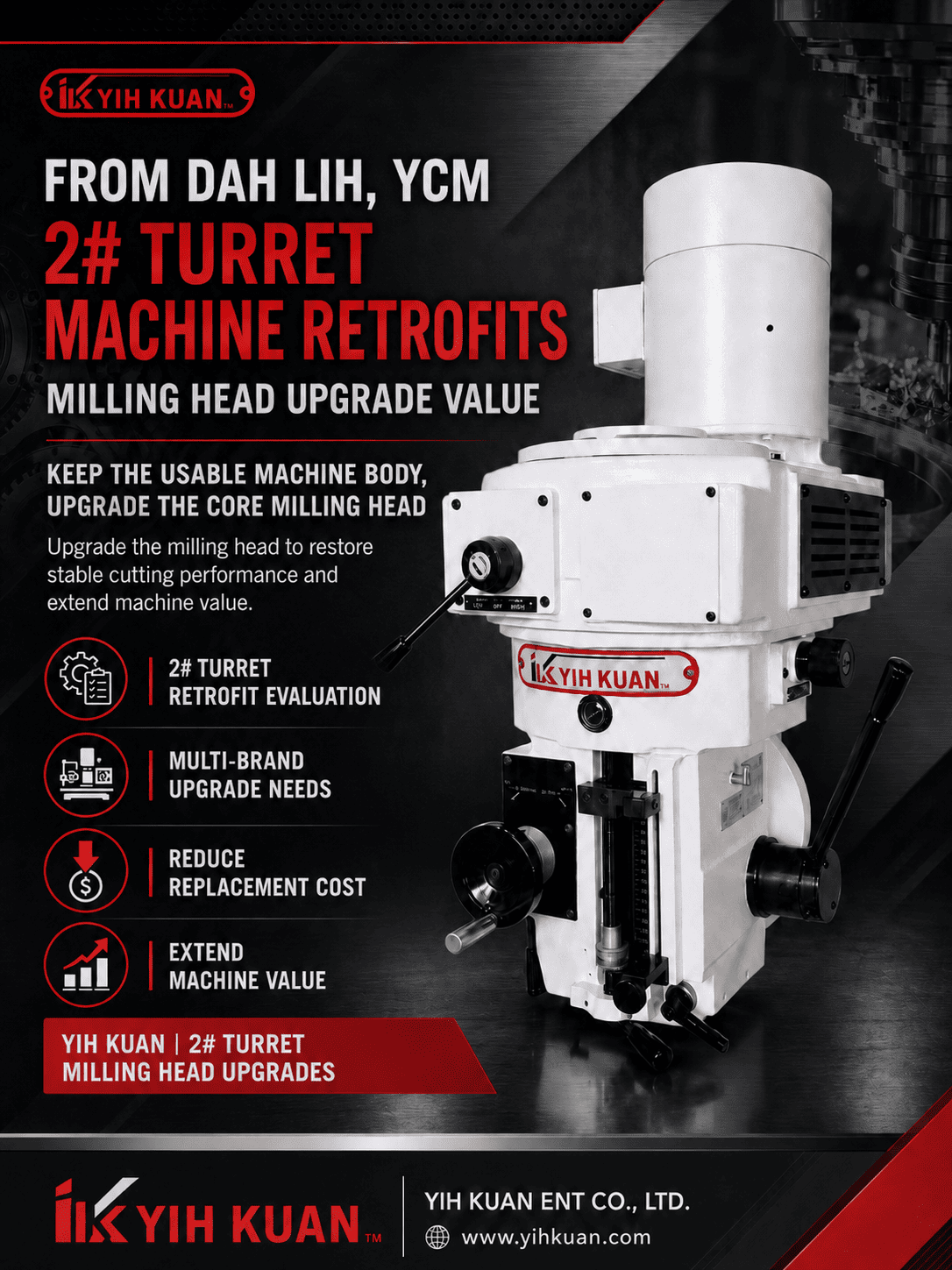
In many traditional machining workshops, 2# turret milling machines remain familiar and highly practical equipment. Although CNC machines are now widely used, traditional turret milling machines still offer advantages such as high operational flexibility, easy maintenance, and relatively low operating costs for mold modification, part reworking, drilling, milling, small-batch machining, and on-site secondary machining.
In the early Taiwan machine tool market, brands such as DAH LIH and YCM also introduced related 2# turret milling machine models. After many years of use, some of these machines still maintain a solid machine body structure, stable worktable, and familiar operating feel. However, due to long-term operation, the milling head may gradually develop issues such as wear, reduced accuracy, unsmooth speed shifting, or difficulty in maintenance.
For machining factories, this does not necessarily mean the entire machine must be replaced. If the machine body remains structurally stable, upgrading or retrofitting the milling head can often restore more stable cutting capability, extend the value of the existing equipment, and reduce the cost pressure of purchasing a new machine.
Old Machines Are Not Necessarily Without Value — The Key Is the Condition of the Core Milling Head
Many factories using older 2# turret milling machines may encounter a common situation: the machine body, worktable, slideways, and basic structure are still usable, but the milling head has begun to affect machining performance.
For example, the spindle may become noisier during operation, cutting vibration may increase, machined surfaces may show chatter marks, quill clearance may become larger, speed shifting may become unsmooth, or replacement parts may become difficult to obtain. These issues may seem like local failures, but they directly affect machining accuracy, operating feel, and production efficiency.
In many cases, it is not that the entire milling machine can no longer be used, but that the milling head can no longer keep up with current machining requirements. If the machine body is still in good condition, replacing or upgrading the milling head can be a more efficient and cost-effective solution.
Why Are 2# Turret Milling Machines Still Worth Keeping?
The reason 2# turret milling machines are still kept in many machining workshops is that they offer high practical value on-site. Compared with large equipment or full CNC machining centers, traditional turret milling machines still provide strong flexibility for temporary machining, mold repair, fixture making, part modification, and small-batch production.
For many machining factories, a 2# turret milling machine may not be the main equipment for daily mass production, but it is often an indispensable auxiliary machine on the shop floor. When a production line needs quick part modification, fixture adjustment, hole reworking, or small-batch machining, a traditional turret milling machine can still provide fast and flexible support.
Therefore, as long as the machine body remains stable, keeping the usable machine body and upgrading the core milling head can allow the existing equipment to continue creating value.
For DAH LIH, YCM, and Other 2# Turret Machines, Interface Confirmation Is the Key to Retrofit
YIH KUAN has previously assisted customers in evaluating milling head retrofit projects for different brands of 2# turret milling machines, including DAH LIH, YCM, and other machines. Since machines from different brands, years, and design batches may have different mounting interfaces, the retrofit evaluation should not only focus on whether the milling head specifications look similar. It is even more important to confirm the actual machine-side conditions.
Common items to confirm during retrofit evaluation include:
- Original machine brand and model
- Appearance and installation method of the original milling head
- Photos of the machine interface after removing the original milling head
- Mounting hole positions and PCD
- Centering diameter
- Number and specifications of screw holes
- Installation space and possible interference conditions
- Voltage and frequency
- On-site machining materials and machining methods
- Problems the customer wants to improve
This information affects whether the new milling head can be installed directly, or whether an adapter design, flange adjustment, or other customized modification is required. For milling head retrofit projects, the key is not only whether the head can be bolted on, but whether it can operate stably, safely, and accurately after installation.
Milling Head Upgrade Is Not Just Maintenance — It Is Equipment Reuse
Traditionally, an old machine may be regarded as equipment that should be replaced. However, from the perspective of equipment reuse, if the machine body structure, worktable, and basic accuracy are still in good condition, and only the milling head condition has declined, replacing the milling head can become an effective upgrade solution.
The value of a milling head upgrade is not only to repair a failure, but also to bring the existing equipment back to a stable machining condition. For machining factories, this approach offers several clear advantages:
- Reduce full-machine replacement cost
- Extend the service life of the original machine
- Preserve the operating habits familiar to operators
- Restore cutting stability and machining efficiency
- Reduce equipment idleness and repeated investment
- Allow older machines to continue supporting on-site machining needs
Therefore, when the machine body still has usable value, upgrading the milling head is not just maintenance. It is a more cost-effective way to reuse existing equipment.
How Does YIH KUAN Help Customers Evaluate Milling Head Upgrades?
YIH KUAN has long focused on the design and manufacturing of milling heads. When facing retrofit requirements for different brands of 2# turret milling machines, YIH KUAN evaluates the project from three main aspects: machine condition, mounting interface, and machining requirements.
- First, confirm whether the machine body is still suitable for an upgrade.
If the machine structure is stable, the worktable condition is good, and the slideways and basic accuracy are still acceptable, then the machine is suitable for further evaluation of a milling head replacement.
- Second, confirm whether the mounting interface can be matched.
The hole positions, centering dimensions, and space layout of different brands of 2# turret machines may vary. Therefore, photos, dimensions, and drawings are required to confirm whether the new milling head can be installed directly or whether a customized adapter is needed.
- Third, confirm the machining requirements and milling head configuration.
If the customer mainly performs general milling, drilling, mold repair, and part modification, YIH KUAN can evaluate a suitable milling head configuration based on the shop floor requirements. If the machine is used for longer operating hours or more varied machining conditions, features such as an inverter motor or oil circulation system can be further evaluated.
For 5HP–7.5HP 2# turret milling machine applications, YIH KUAN can provide different configurations such as IK-6SB2-2#, IK-6S2-2#, and IK-6FS2-2#. Customers can choose whether to use an inverter motor or oil circulation function according to their requirements, making the milling head configuration more suitable for actual machining conditions.
Milling Head Replacement Helps Old Machines Regain Machining Value
For many machining factories using DAH LIH, YCM, or other brands of 2# turret milling machines, an older machine does not necessarily mean it has no value. As long as the machine body remains stable, a suitable milling head upgrade can help improve cutting conditions, enhance operating smoothness, and extend equipment service life.
YIH KUAN believes that a milling head is not merely a replacement part. It is a core module that affects the machining efficiency, stability, and service life of the entire milling machine. When the original machine can still be used, choosing a suitable milling head upgrade solution allows the existing equipment to continue playing an important role in the machining workshop.
Conclusion: Keep the Usable Machine Body and Upgrade the Core Milling Head
The retrofit experience of DAH LIH, YCM, and other 2# turret machines shows that traditional turret milling machines do not always need to be fully replaced simply because the milling head has aged. As long as the machine body still has a solid foundation for use, replacing the milling head and evaluating the interface can help an older machine regain stable machining capability.
For machining factories, instead of immediately investing in a full machine replacement, it is worth first evaluating whether the original machine still has upgrade value. Keeping the usable machine body and upgrading the core milling head can not only reduce costs, but also extend equipment value and allow traditional milling machines to continue providing flexibility and efficiency in modern machining workshops.
YIH KUAN can assist customers in evaluating suitable 2# turret milling head upgrade solutions based on machine brand, mounting interface, and actual machining requirements, helping old machines return to a stable production rhythm instead of being treated only as repair cases.

