Blog
Why Is a Standardized Flange Interface Important for Milling Machine Angle Heads?
2026.04.14
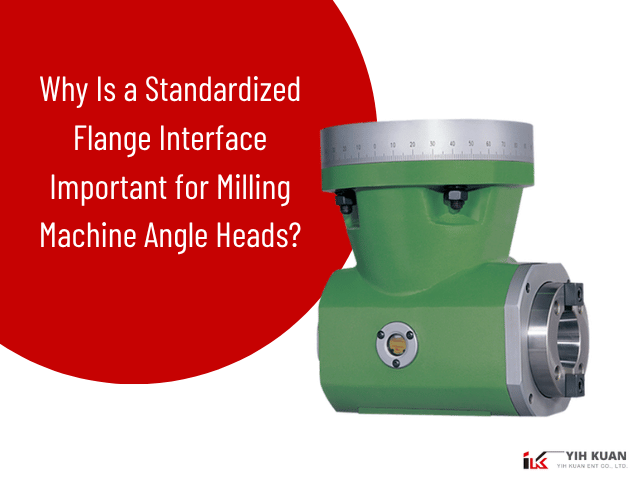
Introduction: The Overlooked Key to Milling Machine Angle Head Performance
When discussing a milling machine angle head, most engineers focus on cutting capacity, angle flexibility, and torque performance. However, one critical design feature is often overlooked: the flange interface.
In real machining applications, the performance of a milling machine angle head depends not only on cutting ability, but also on how well it integrates with the machine tool. A poorly designed or inconsistent flange interface can result in longer setup time, compatibility issues, reduced machining accuracy, and unstable cutting performance.
As manufacturing moves toward high-mix, low-volume production and greater flexibility, fast changeover and easy equipment integration have become increasingly important. YIH KUAN ENT CO., LTD. specializes in the development of milling heads and angle heads for milling machines, helping customers expand machining capability and handle more complex applications. To fully achieve these benefits, standardized flange interface design plays a vital role.
What Is the Flange Interface of a Milling Machine Angle Head?
The flange interface is the key connection structure between the milling machine spindle and the angle head. Its main functions include:
- Ensuring accurate mounting and positioning
- Transmitting spindle torque to the cutting tool
- Maintaining concentricity and machining precision
- Providing the rigidity required during machining
In other words, the flange interface is not just a simple connector. It is a core design element that directly affects the accuracy, stability, and overall performance of the milling machine angle head.
Problems Caused by Non-Standard Flange Interfaces
In many machining environments, different angle heads use different flange interfaces. This can create several practical problems:
- Recalibration is required every time the angle head is changed
- Installation errors are more likely to happen
- ATC (Automatic Tool Changer) settings become more complicated
- More spare parts must be stocked and managed
- Changeover time increases, reducing production efficiency
These problems are especially common in high-mix, low-volume machining environments, where frequent switching between machining tasks is required.
Benefits of a Standardized Flange Interface for Milling Machine Angle Heads
A standardized flange interface allows an angle head to become more than a standalone accessory. It becomes part of a flexible and modular machining system.
1. Faster Changeover and Shorter Setup Time
With a standardized flange interface:
- Different angle heads can be replaced quickly
- Re-alignment and repeated calibration are minimized
- Machine downtime can be significantly reduced
This is especially valuable for manufacturers that need to switch between multiple machining operations.
2. Lower Inventory and Management Costs
A standardized flange design helps reduce operational complexity by allowing:
- One interface to support multiple angle heads
- Fewer spare parts and mounting components
- Simpler storage and easier inventory management
This can reduce both maintenance burden and management cost.
3. Better Compatibility and Greater Machining Flexibility
A standardized flange interface for milling machine angle heads makes it easier to:
- Switch quickly between different machining requirements
- Apply angle heads to different machine configurations
- Simplify equipment integration and implementation
This improves the flexibility of the overall machining system.
4. More Stable Accuracy and Machining Quality
A unified flange interface also helps maintain:
- Consistent positioning reference
- Reduced runout error
- Better machining consistency
- More stable machining quality
For precision machining, flange consistency is a critical factor.
How YIH KUAN Angle Heads Improve Milling Machine Flexibility
YIH KUAN ENT CO., LTD. offers a complete range of angle heads for milling machines to meet different machining requirements, including:
- 90-degree angle heads
- Deep-hole machining angle heads
- 45-degree universal milling heads
- Extended-type angle heads
These milling machine angle heads are widely used in applications such as:
- Side milling
- Side-hole drilling and tapping
- Deep cavity machining
- Inclined surface machining
By selecting the right angle head and combining it with a standardized flange interface, manufacturers can improve machine flexibility and reduce setup time.
YIH KUAN’s Key Advantage: Standardized Flange Interface Design
One of YIH KUAN’s main technical strengths is that different angle heads are designed with a standardized flange interface.
This means:
- Different angle heads can share the same mounting interface
- Replacement can be completed quickly without repeated setup
- The risk of operator error can be reduced
- Changeover time can be significantly shortened
With this design, the milling machine angle head becomes a modular machining solution rather than just a single-purpose accessory.
Applications of Standardized Flange Interfaces in Different Industries
Mold Industry
In mold manufacturing, deep cavity machining and side machining are often required in the same workflow. A standardized flange interface helps reduce setup time and improve machining efficiency.
Automotive Parts Industry
For side-hole machining and cross-hole machining, quick changeover and stable production are essential. Standardized angle head interfaces are ideal for mass production environments.
Aerospace Industry
Aerospace parts often require multi-angle machining with high precision. A stable flange interface helps improve consistency, rigidity, and machining reliability.
General Machine Shops
General machining shops often handle small-batch, high-variety production. Standardized flange systems allow faster response to changing machining requirements.
Key Factors to Consider When Choosing an Angle Head Flange System
- Spindle specifications of the milling machine (NT / BT / CAT / HSK)
- Input and output side compatibility
- ATC automatic tool change requirements
- Through-coolant or center coolant requirements
- Machine load capacity
- Required torque and spindle speed
- Whether the flange interface is standardized
A proper flange match helps avoid installation problems and ensures the best machining performance.
FAQ About Milling Machine Angle Head Flange Interfaces
- Can all milling machine angle head flanges be interchanged?
Not always. Different brands often use different flange designs, so compatibility issues may occur.
- Why is a standardized flange interface important?
A standardized flange interface improves efficiency, reduces setup errors, simplifies operation, and supports faster angle head replacement.
- Can a standardized flange interface improve productivity?
Yes. It is especially useful in machining environments that require frequent tool changes, fast setup, and flexible production.
- Does flange design affect machining accuracy?
Yes. Flange design directly affects concentricity, rigidity, runout performance, and machining stability.
Conclusion: Why Standardized Flange Interfaces Matter
In modern machining, productivity depends not only on cutting performance, but also on setup efficiency, machine integration, and operational flexibility.
By adopting a standardized flange interface for milling machine angle heads, manufacturers can:
- Reduce setup time
- Improve machining stability
- Lower operational complexity
- Increase machine utilization
- Build a more flexible machining environment
With years of experience in milling head manufacturing, YIH KUAN ENT CO., LTD. provides a wide range of angle heads for milling machines and helps customers improve efficiency through standardized flange interface design.
If you want to improve machining capability without increasing equipment investment, choosing a milling machine angle head with a standardized flange interface can be a highly effective solution.

