Blog
Maintenance Key Points for Milling Heads: Cultivating the Habit of Regular Maintenance
2026.03.20
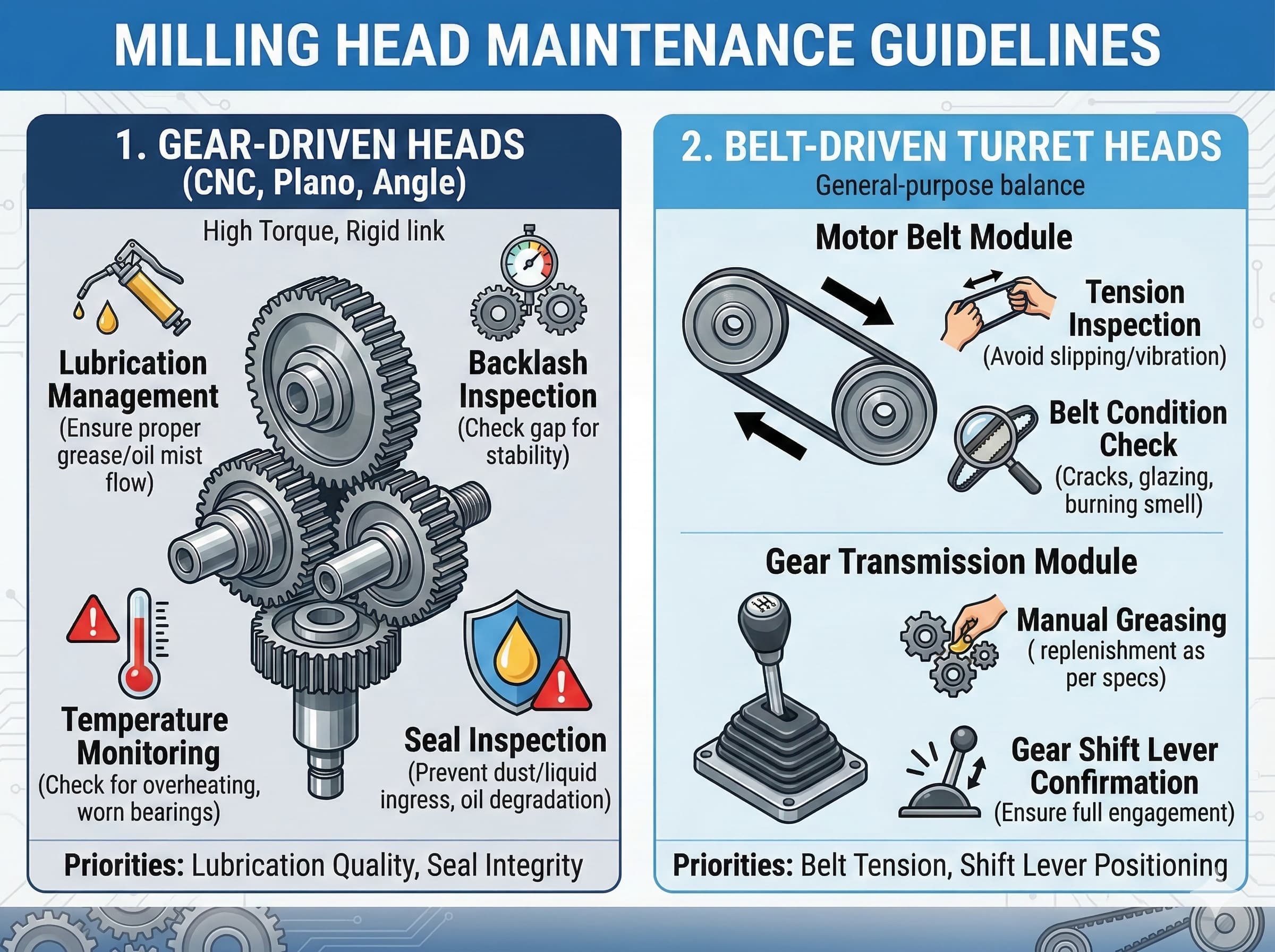
Extending the Lifespan of Gear-Driven CNC Spindle Heads, Plano Milling Heads, Angle Heads, and Belt-Driven Turret Milling Heads
Investing in high-performance milling heads is not just about pursuing machining precision; it is also about extending equipment life and reducing the risk of downtime through proper maintenance. Different types of milling heads vary in structure and transmission methods, meaning their maintenance priorities also differ. There are distinct differences in the maintenance approach for full gear-driven milling heads compared to belt-driven turret milling heads.
1. Full Gear-Driven Milling Heads
(Applicable to Gear-Driven CNC Spindle Heads, Plano Milling Heads, and Angle Heads)
These milling heads use gears to transmit high torque directly; therefore, lubrication and seal management are the keys to maintenance.
Maintenance Priorities
- Lubrication Management: Ensure that the grease or oil mist system is operating normally. Insufficient lubrication can easily lead to gear wear, pitting, abnormal noise, and may even affect machining accuracy.
- Backlash Inspection: Mechanical gaps may increase after long-term heavy cutting. Regularly checking the backlash can avoid impact during forward and reverse switching, maintaining transmission stability.
- Temperature Monitoring: If the housing temperature rises abnormally during machining, it may indicate lubrication issues or bearing wear; inspections should be carried out as early as possible.
- Seal Inspection: If external dust or liquid penetrates the interior, it may cause the lubricant to emulsify or deteriorate, leading to gear oxidation and damage. Therefore, seals must be confirmed regularly.
2. Belt-Driven Turret Milling Heads
Turret milling heads utilize a belt-driven design, but maintenance must focus on both the motor belt module and the gear transmission module.
Motor Belt Module
- Tension Inspection: Over-tightened belts affect operational stability and accelerate belt wear; over-loosened belts lead to slippage and vibration. Either condition can cause milling head vibration, so regular tension checks are recommended.
- Belt Condition Check: If the belt shows cracks, wear, glazing, or is accompanied by a burning smell or black dust, it usually means the belt is nearing the end of its lifespan and should be replaced.
Gear Transmission Module
- Manual Greasing: The gear shifting mechanism usually requires manual grease replenishment. This should be performed regularly according to maintenance specifications to maintain optimal transmission status.
- Gear Shift Lever Confirmation: High and low-speed levers must be fully engaged. Failure to do so can cause poor gear meshing and, in severe cases, lead to broken gear teeth.
Maintenance Priority Comparison
| Item | Full Gear-Driven Milling Head | Belt-Driven Turret Milling Head |
|---|---|---|
| Primary Focus | Lubrication Quality, Seal Integrity | Belt Tension, Shift Lever Positioning |
| Daily Check | Lubrication System, Oil Level, Operating Temp | Abnormal Noise, Vibration, Belt Condition |
| Monthly Check | Spindle Runout, Seal Condition | Clean Pulleys, Check Belt Wear |
| Annual Maintenance | Gearbox Cleaning, Oil Change | Preventive Belt Replacement, Grease Check |
Common Questions (Q&A)
Q: Can I use general industrial grease for angle heads?
A: Not recommended. The high-speed gears in angle heads require specific lubrication specs that meet certain viscosity and extreme pressure requirements. Recommended oils should be used to ensure stability and protection during high-speed operation.
Q: How can I tell if the turret milling head belt needs replacement?
A: If black dust, a burnt rubber smell, or unstable spindle speeds occur, it usually indicates the belt is worn. It is recommended to check and replace it as soon as possible.
Q: Is it normal for a gear-driven head to get hot after long hours of machining?
A: A slight rise in temperature is normal. However, if the housing becomes significantly hot, you should further check the lubrication status, bearing wear, or whether there is abnormal internal resistance.